Twenty years ago this month, I walked into a nursing home as a volunteer with a simple goal: to see how helpful it would be if residents reconnected to their own music
I kept coming across residents who would “light up” to their delight at hearing a favorite tune. I started wondering: Why isn’t everybody doing this? How do we roll out individualized music to scale?
Two decades later, after founding Music & Memory in 2010 and training more than 5,000 care homes, hospitals and other settings, and then creating Right to Music in 2019 to accelerate adoption, I’m reflecting on what we’ve learned.
Music can fundamentally improve lives for people living with dementia, their families, and other caregivers. Yet, generating widespread, systemic adoption remains a massive challenge.
Is it ageism? Stigma? Institutional lethargy? Fundamentally, I believe it’s simply a lack of awareness of the depth and range of music’s benefits—and the huge opportunity within our grasp.
A Lost Connection
Globally, surveys show that the average person listens to music for approximately two hours a day, totaling roughly 1.2 million songs over a lifetime. Two out of three people state that music is vital to their mental health and well-being.
Yet, when cognitive decline hits, that lifelong connection is often abruptly severed.
Care homes globally offer music, but it is often highly variable, sporadic and geared generally toward group interest. At home, families are often stressed by care needs and simply unaware of music’s special relevance and impact. Either way, no matter how important music has been to someone’s life, it can be forever lost to them.
Our expectation is that medical professionals prescribe medications that maximize health improvement. Music in all its forms—live performance, singing, dancing, playing an instrument, and enjoying one’s playlist—the more we can match it to individual preferences, the more impact on mood, behavior, and quality of life. Therefore, why aren’t we taking the same precise, individualized, maximalist approach with music as with medication?
Before he passed away, Dr. Peter Davies, a leading Alzheimer’s researcher, told me something I will never forget:
“If I could only discover a drug that generates outcomes similar to music, it would be an instant, multi-billion-dollar product. Every doctor would prescribe it and every family would want it.”
The Cascade of Benefits: With the Right Approach, It Just Works
Unlike drugs that target a single or limited set of symptoms, music acts more broadly, often sparking a cascade of cognitive and emotional benefits.
When I started, I thought re-connecting people with their favorite music would help with mood. I did not expect to get feedback pointing to reduced falls, pain, depression, anxiety, brain fog, caregiver stress (for both families and direct care staff at work), and improved gait, speech, memory, and social interaction.
For example, here’s an initiative by New York City Health + Hospitals, which gave 100 patients with advanced dementia personalized music twice a day. When I visited their massive day room, the nurse in charge asked me what I noticed. I looked around and said, “It’s incredibly quiet.”
The music had induced a delightfully calmer state. The nurses were thrilled; instead of constantly focusing on a half-dozen distressed individuals, they could finally distribute their care equitably to all 100 residents.
At the end of the study period, the clinical data revealed some surprising and hospital-relevant outcomes:
- There was a significant reduction in the transfer of residents to psychiatric ERs for behavioral and psychological symptoms of dementia (BPSD).
- There was a significant reduction in falls and physical altercations, resulting in a drop in transfers to acute hospitals for further management.
- Constant one-to-one observations decreased from five to just one during the same period.
The Missing Link: Timing and Policy
If it works so well, why isn’t it standard practice to prioritize music’s impact in care settings?
Currently, when families interact with physicians, neurologists, and healthcare professionals before or after diagnosis, music is rarely mentioned.
Dementia support organizations are ideally positioned to bridge this gap. We’ve learned that timing is everything. Care homes usually receive residents in the later stages of the disease, when they may no longer be able to articulate their preferences, and family members might not know the specific songs of their youth.
Organizations like the Alzheimer’s Society of Toronto and the Dementia Alliance of North Carolina, which provide families with personalized music players, succeed (more than 90 percent of the time!) because they catch families early—around the time of diagnosis—when the individual can still tell us which songs, or artists/groups move them.
The Next 20 Years: A Call to Action
Unlike drugs, there is no need to prove efficacy beyond a shadow of a doubt. As Grace Meadows, creator of Music for Dementia and musiccan.uk, has said, it is important to use the right music at the right time, in the right way, and by the right person. This approach helps generate success. We have everything to gain when it works and nothing to lose if it doesn’t. Everyone has a right to any tool that helps maintain a sense of self, connection with others, meaningful engagement, and one that enables the prompting of memories along the way.
Let’s keep those close to us connected with their music. Incredible research even shows that music is associated with a reduced risk of developing dementia in the first place—up to a 39 percent reduced risk from listening to music every day, and 33 percent from playing music.
But to achieve true, widespread adoption, we need to move from heartwarming stories to institutional mandates.
- We need policy change: When music-based interventions are built into government health policies, they are adopted automatically, not optionally. Alzheimer’s and dementia support programs can easily improve quality of life by promoting music as a priority; by offering training and community programs; and by increasing awareness of music’s impact.
- Clinicians can recommend music: Each healthcare professional working with or diagnosing dementia needs to prescribe music right alongside any pharmaceutical interventions. Meds without music is a missed opportunity.
- Have the music follow the person: Just as we do with medication lists, a person’s musical profile should travel with them. It is an incredible gift if the stress of a changed location—whether a hospital, hospice, or care home—can be eased by keeping people engaged with their familiar music.
What You Can Do Today
If you have a loved one living with dementia, or if you are thinking about your own future, don’t wait. When you think of dementia, think music. Do not wait until someone can no longer articulate their preferences. Sit down today, find out what artists and songs make them light up, and write it down. Build the playlist now. Make it accessible every single day. For those who are not convinced, encourage them to watch Alive Inside (on YouTube, Amazon Prime or Apple TV). The film both reduces stigma and moves people to act.
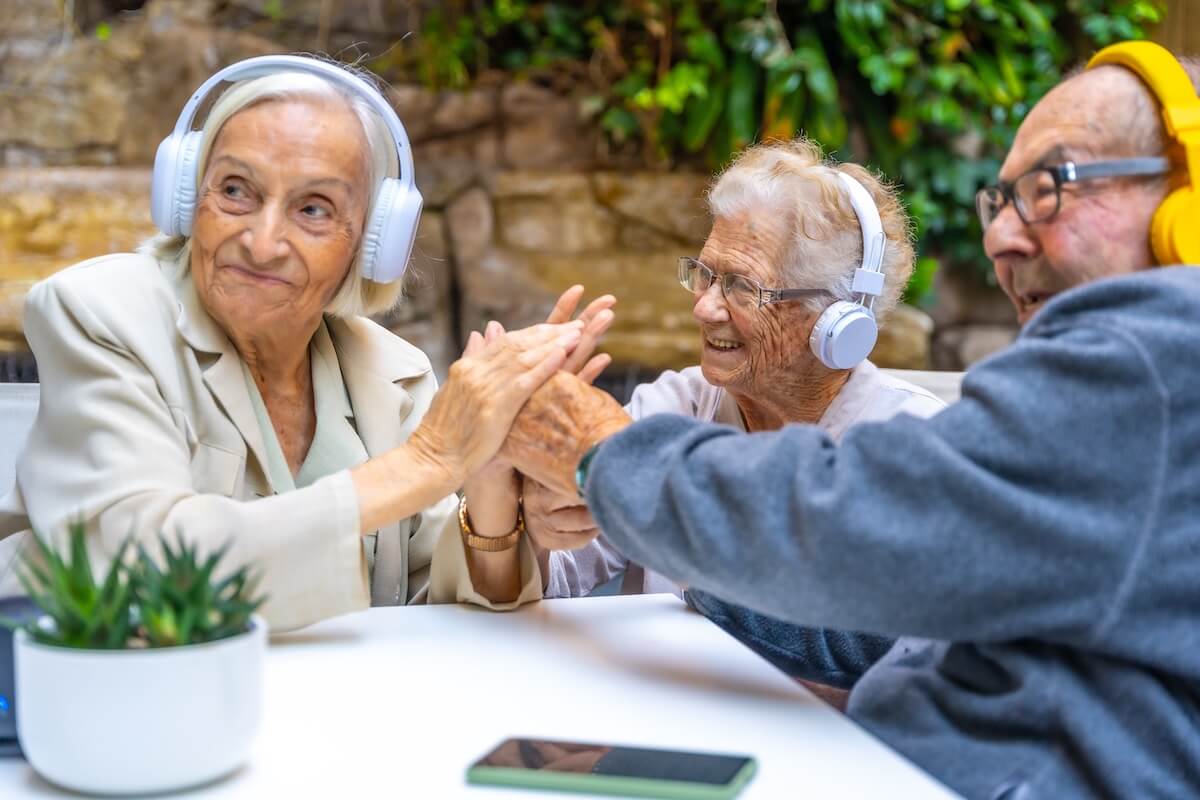
Go beyond the headphones, too. Our life’s experience with music spans singing, dancing, and playing instruments. Each of these lights up different, vital parts of the brain:
- Dementia choirs have multiple documented benefits, reducing feelings of loneliness and providing a shared, joyful experience (you can learn more from organizations like Giving Voice).
- Dance stimulates cognition, improves mood, fosters social connection, and significantly reduces agitation and anxiety.
- Use live and recorded performances, smart speakers, YouTube Music, local dances, religious ceremonies
- Play an old, favorite musical instrument or or use any simple percussion instrument to liven things up.
The closer we align these music-based interventions with a person’s exact preferences, the more successful we will be. Let’s take the time, as we do with medications, to get it right. Everyone wins.
Two more things:
To learn more about accelerating music adoption in our communities, sign up for the first Music & Dementia Global Forum—Accelerating Music Access for All, a free virtual 3 ½ hour online forum, September 23, 2026, 9:00 a.m. Eastern Time.
To learn more about best practice music and dementia programs internationally, click here.